Earth Bank
a Living Building System engineered by Matt Brooke and Walter Cicack
Earth Bank is a concept for a new kind of cast in place wall that is rigid like a concrete panel but contains and supports living plants which grow and envelop it. This concept is currently envisioned as a partition wall or wall sheathing system and is not currently being engineered for structural applications.
The primary engineering task in creating the Earth Bank is to experiment with a variety of different cementitious mixtures in order to find one or more that fit the following criteria:
1. The Earth Bank must be rigid enough to support its own weight and coherent enough not to fall apart. It is intended to degrade and erode over time, but over the course of years, not weeks or months.
2. The Earth Bank must provide a viable living substrate for grasses, flowers, and annual/perennial herbaceous plants. The Earth Bank should provide these plants all of the air and fertilizer they need to grow and reproduce, with the intention being that the Earth Bank is self-seeding and does not need to be replanted after installation. Water for these plants will be provided by either rainwater or an irrigation system depending on the particulars of a given installation.


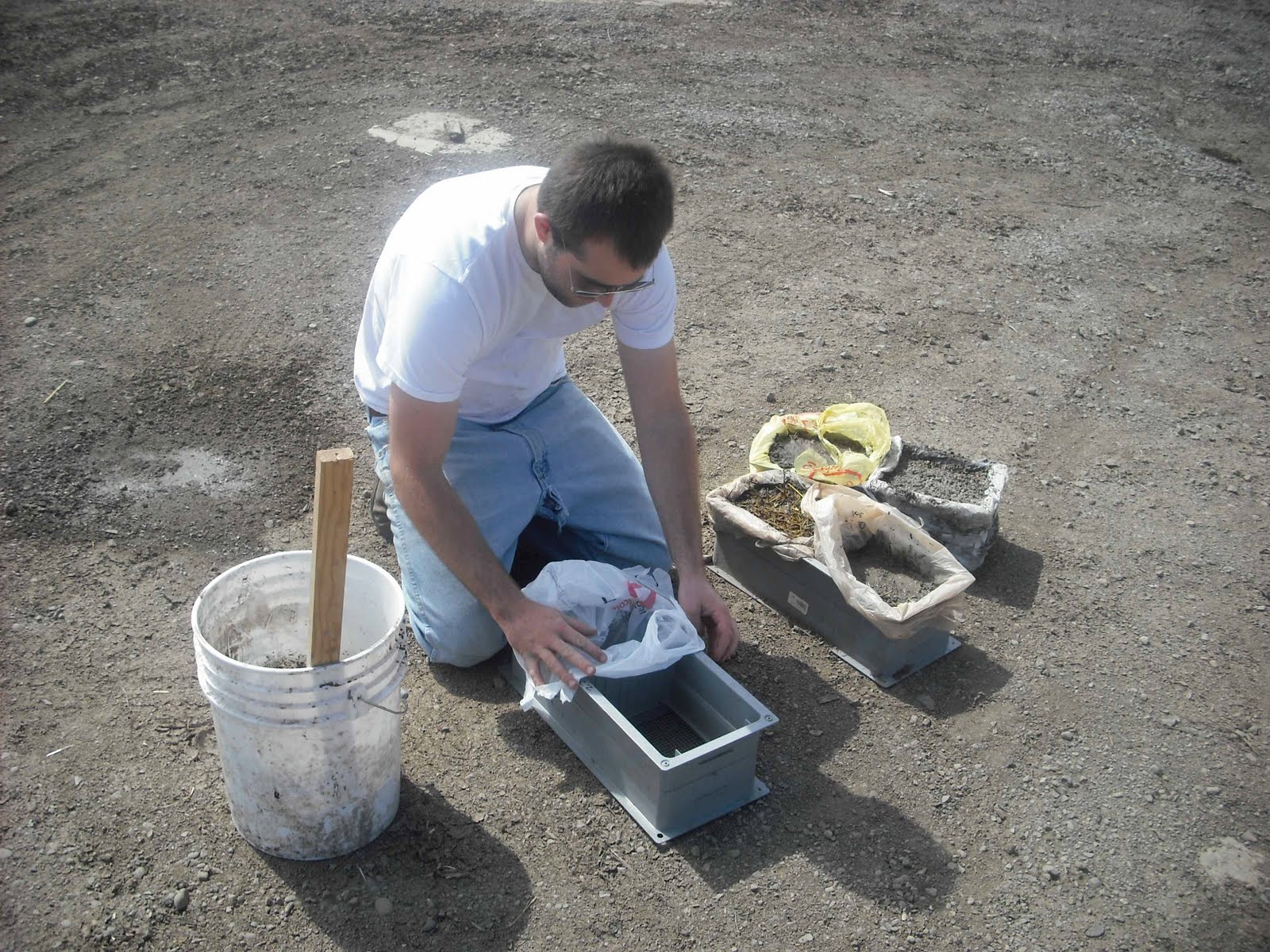
In order to test the different mixtures for the Earth Bank, we decided to pour several small test blocks in improvised brick molds (recycled vent housings from Bring Recycling Center). With eight brick molds, we are able to test eight different mixtures a week. We plan to do three sets of eight blocks a piece and after each round to further clarify and refine the mixture.
In order to give ourselves the best possible chance of finding a viable mixture for the Earth Bank, we have acquired a broad palate of possible materials. They list as following:
Mortars:
lime – acquired from Jerry's hardware
Portland cement – acquired from Jerry's hardware
Aggregates:
perlite – acquired from Aqua-Serene hydroponic supply
red cinder lava rock – acquired from Lane Forrest Products
sand – acquired from Lane Forrest Products
Organic Substrates:
organic soil – acquired from Lane Forest Products
organic compost – acquired from Lane Forrest Products
Organic Fibers/Binders:
straw – acquired from Lane Feed Supply
coconut fiber – acquired from Aqua-Serene hydroponic supply
peat – acquired from our professor, Rich Hindel
Seeds:
different varieties of turf grass indigenous to the Willammette Valley – acquired from Irwin and Son's seed supply
wildflowers native to the Willammette Valley – acquired from Irwin and Son's seed supply
various wild sedum, vines and weeds – acquired from various wild locations in Eugene, Or


Hypertufa:
Hypertufa is an artificial stone product made by adding various low-density aggregates to portland cement. It is similar to the Earth Bank concept in that it is a light weight version of concrete which can be poured and shaped like traditional concrete. Hypertufa has not been conceived as a living plant medium; it serves us as a precedent because it successfully lowers the weight and density of a concrete mixture by using peat and perlite as aggregates, a concept which we have incorporated into our various Earth Bank test mixes.


Construction Schedule:
The first round of test bricks were poured on Monday July 5th, and the second round was poured a week later on Monday July 12th. We are hoping to get another round of the test bricks poured by Thursday July 15th and another poured early on the week of the 19th. Ideally, we would like to get at least four or five rounds of eight test bricks a piece poured before we pour the final product in early August. Each round of test bricks gives us valuable data to inform successive trials; we hope to get as much data as possible to inform the engineering of our final product.